High-density reference
Overview Map
The major physiology, presentations, diagnostic patterns, treatment priorities, and anesthesia implications from this source document.
Main Focus
- Use chemical structure to predict onset, storage, receptor location, protein binding, and duration of hormone action.
- Localize disorders as primary, secondary, or tertiary by comparing target-gland hormones with pituitary trophic hormones.
- Differentiate anterior-pituitary portal regulation from posterior-pituitary axonal transport and storage.
- Anticipate the acromegaly airway, cardiac disease, OSA, metabolic dysfunction, and positioning difficulty.
- Plan transsphenoidal surgery around smooth emergence, graft protection, neurologic assessment, and postoperative DI.
- Distinguish DI from SIADH using urine output, sodium, plasma osmolarity, and urine concentration.
- Interpret calcium symptoms using ionized calcium, pH, albumin, magnesium, phosphate, and ECG.
- Recognize postoperative stridor from neck hematoma, RLN injury, or hypocalcemic laryngospasm.
Presentation
- Prolactinoma: galactorrhea, amenorrhea, infertility, reduced libido.
- Acromegaly: macroglossia, prognathism, soft-tissue overgrowth, OSA, hypertension, cardiomyopathy, glucose intolerance, arthropathy.
- Neurogenic DI: abrupt high-volume dilute urine, hypernatremia, rising plasma osmolarity, weakness, lethargy, seizures.
- SIADH: dilutional hyponatremia with low plasma osmolarity and inappropriately concentrated urine; edema is not typical.
- Hypocalcemia: paresthesias, cramps, hyperreflexia, Chvostek sign, Trousseau sign, tetany, prolonged QT, laryngospasm.
- Hypercalcemia: “stones, bones, groans,” dehydration, weakness, lethargy, shortened QT, conduction changes.
Epidemiology
- The anterior pituitary makes up about 80% of gland weight.
- Prolactinoma is the most common hypersecreting pituitary tumor in the source guide.
- About 15% of pituitary tumors hypersecrete growth hormone.
- OSA is reported in more than 60% of patients with acromegaly.
- Arthropathy is reported in about 75% of acromegaly cases.
- A single adenoma causes about 80% of primary hyperparathyroidism cases.
Etiology
- Pituitary hyposecretion: mass, Sheehan syndrome, stalk damage, trauma, infection, irradiation, or infiltrative disease.
- Pituitary hypersecretion: most often a benign microadenoma; consider MEN-1 when pituitary, parathyroid, and pancreatic tumors cluster.
- Neurogenic DI: pituitary/hypothalamic surgery, head injury, tumor, meningitis, encephalitis, or infiltration.
- Nephrogenic DI: renal ADH resistance from lithium, amphotericin B, cisplatin, hypercalcemia, hypokalemia, or renal disease.
- Hypoparathyroidism: most commonly postoperative gland injury or removal.
- Hyperparathyroidism: usually a single adenoma; consider MEN-1 or MEN-2A in younger patients.
Diagnostics
- Acromegaly: focused airway history, neck examination or imaging when indicated, ECG, echocardiography, OSA assessment, and glucose review.
- DI: urine osmolarity below about 200 mOsm/L, specific gravity below 1.010, rising serum osmolarity and sodium.
- SIADH: sodium below 135 mEq/L, plasma osmolarity below about 270 mOsm/L, urine osmolarity above about 100 mOsm/L.
- Calcium: evaluate ionized calcium, total calcium, albumin, magnesium, phosphate, creatinine, pH, and ECG.
- Intraoperative PTH: a fall greater than 50% from baseline within about 10 minutes supports successful removal.
Treatment
- Prolactinoma: dopamine agonist therapy is generally first-line.
- Neurogenic DI: desmopressin plus controlled free-water and electrolyte replacement.
- Nephrogenic DI: remove the cause when possible and correct contributing electrolyte abnormalities.
- SIADH: treat the cause, fluid restriction, cautious hypertonic saline for severe symptoms, and selected vaptans.
- Symptomatic hypocalcemia: airway support, ECG monitoring, IV calcium gluconate, and magnesium correction.
- Hypercalcemia: restore volume with isotonic saline and treat the underlying cause; surgery may be curative.
Pearls
- A normal Mallampati score does not exclude the extensive acromegaly airway changes below the tongue.
- Avoid nasotracheal instrumentation in acromegaly because turbinate enlargement increases trauma and bleeding risk.
- Smooth emergence after transsphenoidal surgery protects the sellar repair and limits ICP surges.
- Desmopressin works in neurogenic DI but not in nephrogenic DI.
- Hyperventilation can precipitate tetany by lowering ionized calcium even when total calcium is normal.
- Hypomagnesemia can make hypocalcemia refractory because magnesium is required for normal PTH secretion.
- Hypercalcemia shortens QT; hypocalcemia prolongs QT.
- Postoperative stridor after neck surgery is an airway emergency until hematoma, bilateral RLN injury, and hypocalcemia are distinguished.
Mechanism before memorization
Pathophysiology Step-Through
Select a pathway and move one step at a time. The complete text is embedded in the initial HTML for indexing and printing.
Postoperative Neurogenic DI
Step 1
Central ADH delivery is disrupted
Pituitary or hypothalamic surgery can reduce ADH synthesis, transport, storage, or release.
Collecting ducts stop retaining free water
Without adequate V2-receptor signaling, aquaporin insertion falls and the kidney cannot conserve water.
Urine dilutes while plasma concentrates
Urine output rises, urine specific gravity and osmolarity fall, and serum sodium and osmolarity climb.
Volume and neurologic consequences develop
Continued losses cause dehydration, weakness, hyperreflexia, lethargy, seizure, or coma.
Desmopressin restores V2 activity
Neurogenic DI responds to desmopressin, while nephrogenic DI requires treatment of renal resistance and contributing causes.
Growth hormone excess drives tissue overgrowth
Excess GH and IGF-1 enlarge bone, cartilage, and soft tissue throughout the airway and body.
Upper and lower airway anatomy changes
Macroglossia, prognathism, enlarged epiglottis/vocal cords, subglottic narrowing, and turbinate enlargement develop.
OSA and cardiomyopathy reduce reserve
Sleep apnea, hypertension, LVH, diastolic dysfunction, and possible heart failure increase perioperative risk.
Musculoskeletal disease complicates positioning
Arthropathy, kyphosis, and bone fragility make neuraxial access and safe positioning harder.
Plan an advanced airway strategy
Assess symptoms and imaging, prepare video/fiberoptic equipment, avoid nasal instrumentation, and have rescue plans available.
PTH falls after gland injury or removal
Parathyroidectomy or inadvertent parathyroid injury reduces PTH-mediated calcium conservation.
Ionized calcium declines
Calcium may fall further with citrate exposure, alkalosis, bicarbonate, diuresis, or hypomagnesemia.
Excitable membranes become hyperactive
Lower calcium reduces the threshold for nerve and muscle activation, causing paresthesia, cramps, tetany, and hyperreflexia.
Airway and cardiac danger appear
Laryngeal spasm can cause stridor or asphyxia, while QT prolongation increases dysrhythmia risk.
Treat calcium and contributing factors
Provide airway support, IV calcium gluconate for symptomatic disease, ECG monitoring, and magnesium correction.
Pattern recognition
Differential Comparison
Use the selectors to compare related or easily confused concepts across mechanism, presentation, diagnostics, and perioperative priorities.
Diabetes Insipidus vs SIADH
Opposite disorders of ADH effect.
| Parameter | Diabetes Insipidus | SIADH |
|---|---|---|
| Core defect | Too little ADH effect: deficient central release or renal resistance. | Excess ADH effect despite low physiologic need. |
| Urine output | Very high, sometimes 8–12 L/day. | Low or inappropriately limited. |
| Urine concentration | Very dilute; low osmolarity and specific gravity. | Inappropriately concentrated. |
| Serum sodium | Rising sodium or hypernatremia. | Dilutional hyponatremia. |
| Plasma osmolarity | High. | Low. |
| Volume pattern | Free-water deficit and possible hypovolemia. | Mild hypervolemic physiology without typical edema. |
| Treatment | DDAVP for neurogenic DI; correct cause/electrolytes for nephrogenic DI. | Fluid restriction, cause treatment, cautious hypertonic saline for severe symptoms, possible vaptans. |
| Main safety issue | Rapid dehydration and hypernatremic neurologic injury. | Osmotic demyelination if chronic hyponatremia is corrected too quickly. |
Hypocalcemia vs Hypercalcemia
Use neuromuscular findings, QT direction, and volume status.
| Parameter | Hypocalcemia | Hypercalcemia |
|---|---|---|
| Typical mechanism | Low PTH, vitamin D deficiency, citrate, alkalosis, or hypomagnesemia. | Primary hyperparathyroidism, malignancy, or other causes of calcium excess. |
| Neuromuscular | Paresthesia, cramps, tetany, Chvostek, Trousseau, laryngospasm. | Weakness, hypotonia, lethargy, confusion. |
| ECG | Prolonged QT. | Shortened QT; conduction abnormalities. |
| GI/renal | Possible abdominal symptoms but neuromuscular signs dominate. | Stones, constipation, nausea, pancreatitis, impaired concentrating ability. |
| Airway issue | Laryngeal tetany can cause stridor or asphyxia. | Sedation may worsen existing CNS depression; dehydration is common. |
| Treatment | IV calcium for symptomatic disease; correct magnesium. | Isotonic saline and cause-directed treatment; surgery for appropriate primary disease. |
Anterior vs Posterior Pituitary
Different anatomy, control, and perioperative consequences.
| Parameter | Anterior Pituitary | Posterior Pituitary |
|---|---|---|
| Tissue type | True endocrine tissue; about 80% of gland weight. | Neural extension that stores and releases hypothalamic hormones. |
| Control route | Hypothalamic releasing/inhibiting hormones via portal circulation. | Axonal transport from hypothalamic nuclei. |
| Hormones | GH, ACTH, TSH, FSH, LH, prolactin. | ADH and oxytocin. |
| Common anesthesia issue | Acromegaly airway, pituitary hormone deficiency, tumor mass effect. | DI, SIADH, vasopressin effects, oxytocin hemodynamics. |
| Surgical concern | Tumor resection, graft protection, rapid neurologic assessment. | Postoperative water-balance disorders requiring frequent sodium and urine monitoring. |
Five-question checkpoint
Interactive Review Quiz
Select one answer for immediate feedback. Every explanation is available in the initial document under an expandable details block.
A postoperative pituitary patient produces 600 mL/hour of urine with a specific gravity of 1.002 and rising sodium. What is most likely?
Detailed explanation
Correct: neurogenic diabetes insipidus. The combination of very high urine output, dilute urine, and rising serum sodium indicates inadequate ADH effect after pituitary surgery.
- SIADH: would cause concentrated urine and hyponatremia.
- Fluid overload: does not explain progressive hypernatremia with very dilute urine.
- Hyperparathyroidism: does not fit the immediate postoperative pattern.
Why is nasotracheal instrumentation generally avoided in acromegaly?
Detailed explanation
Correct: turbinate hypertrophy makes the nasal route more traumatic. Acromegaly can enlarge turbinates and other airway tissues.
- GH suppression: is not the reason.
- SIADH: is unrelated to the nasal route.
- PTH monitoring: is unrelated to airway route selection.
Which change confirms likely removal of hypersecreting parathyroid tissue?
Detailed explanation
Correct: a greater-than-50% PTH fall within about 10 minutes. The short PTH half-life makes this a useful intraoperative marker.
- PTH rise: suggests continued secretion.
- Immediate zero calcium: is neither expected nor desirable.
- Urine calcium: is too indirect and slow for intraoperative confirmation.
A hyperventilated patient develops carpopedal spasm despite a normal total calcium. What is the mechanism?
Detailed explanation
Correct: alkalosis increases calcium binding to albumin and lowers the active ionized fraction. Total calcium may remain normal.
- Acidosis: tends to increase ionized calcium by displacing it from protein.
- PTH increase: would oppose hypocalcemia.
- Calcitonin/hyperkalemia: does not explain the presentation.
Which postoperative finding after parathyroidectomy is an immediate airway emergency?
Detailed explanation
Correct: stridor with neck swelling or tetany. The differential includes hematoma, bilateral RLN injury, and hypocalcemic laryngospasm—all urgent.
- Mild nausea: is nonspecific.
- Small calcium decline: requires monitoring but is not itself an airway emergency.
- Normal voice: is reassuring rather than dangerous.
Anatomy + mechanism
Visual Lab
Use the source illustrations for spatial orientation, then manipulate the interactive diagrams to connect gland anatomy with hormone pathways, calcium physiology, and perioperative decisions.
NIH Anatomy Reference
Switch between the pituitary’s bony location and a whole-body map of MEN1-associated endocrine organs.
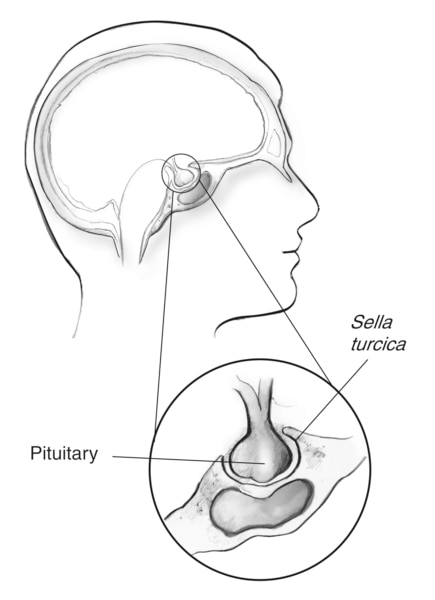
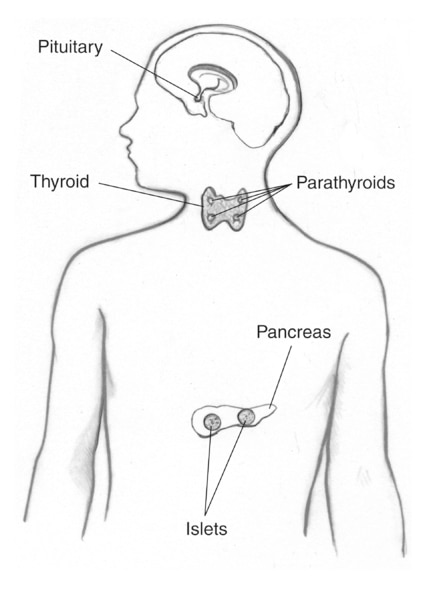
Pituitary Axis Explorer
Select a hormone to trace source → signal → target and reveal the anesthesia-relevant failure pattern.
Excess: acromegaly
Macroglossia, prognathism, OSA, cardiomyopathy, hypertension, glucose intolerance, and difficult positioning.
Anesthesia focus: Plan for a difficult airway, avoid traumatic nasal instrumentation, evaluate cardiac function, and monitor glucose.
Ionized Calcium–pH Demonstrator
Move pH to visualize the direction of albumin binding and the active ionized calcium fraction. This is conceptual, not a dosing calculator.
Physiologic range
Protein binding and ionized calcium are relatively balanced.
Clinical cue: Interpret symptoms with ionized calcium, ventilation, magnesium, and ECG—not total calcium alone.
Post-Neck-Surgery Stridor Triage
Choose a cause to review the discriminator and first priority.
Expanding neck hematoma
Clues: Neck swelling or firmness, pressure, dysphagia, tracheal deviation, rapidly worsening distress.
Immediate priority: Call for surgical help, oxygenate, prepare for urgent decompression and airway rescue; do not delay for imaging in a crashing patient.